
Vol 4, Issue 2: readme through the ages (PDF)
the issue in which we take a brief but thorough look at our history
Rejected Headlines
- CMU passes the Bechdel test after Margaret Morrison merger.
- ReadMe a huge proponent of meth as children's study aid.
- Tartan slanders innocent billionaire, more at 11.
- CMU football wins ten consecutive Heismans, CMU students still not going to games.
- Noah complains that God's 'gone woke' after Ark flooded.
- This dumbass thinks he can repay all of our sin debt.
- ReadMe bigger than Beatles, says Jesus.
- ReadMe so funny that they invented CMU to house it.
- My strong opinions on the Middle East - an essay.
- "I'm still alive guys," Elvis, 1978
- I don't know how to spell Renassance either, French people assure us.
- "I had no clue he was gay," Leonardo DaVinci's third apprentice twink claims.
- Sliced bread invented. Honestly, not that cool.
- "Sorry guys, I'm actually dead this time." Elvis, 1979.
- Creator of Bradford pear tree amongst first to be killed on invention of time travel.
- Victorian Child unimpressed by current labor standards, "You can't do anything these days!"
- Two women argue about twins, King Solomon demands both be cut in half.
- What was Copernicus' problem? Well, that man was a Pisces.
All this and more, not in this issue!
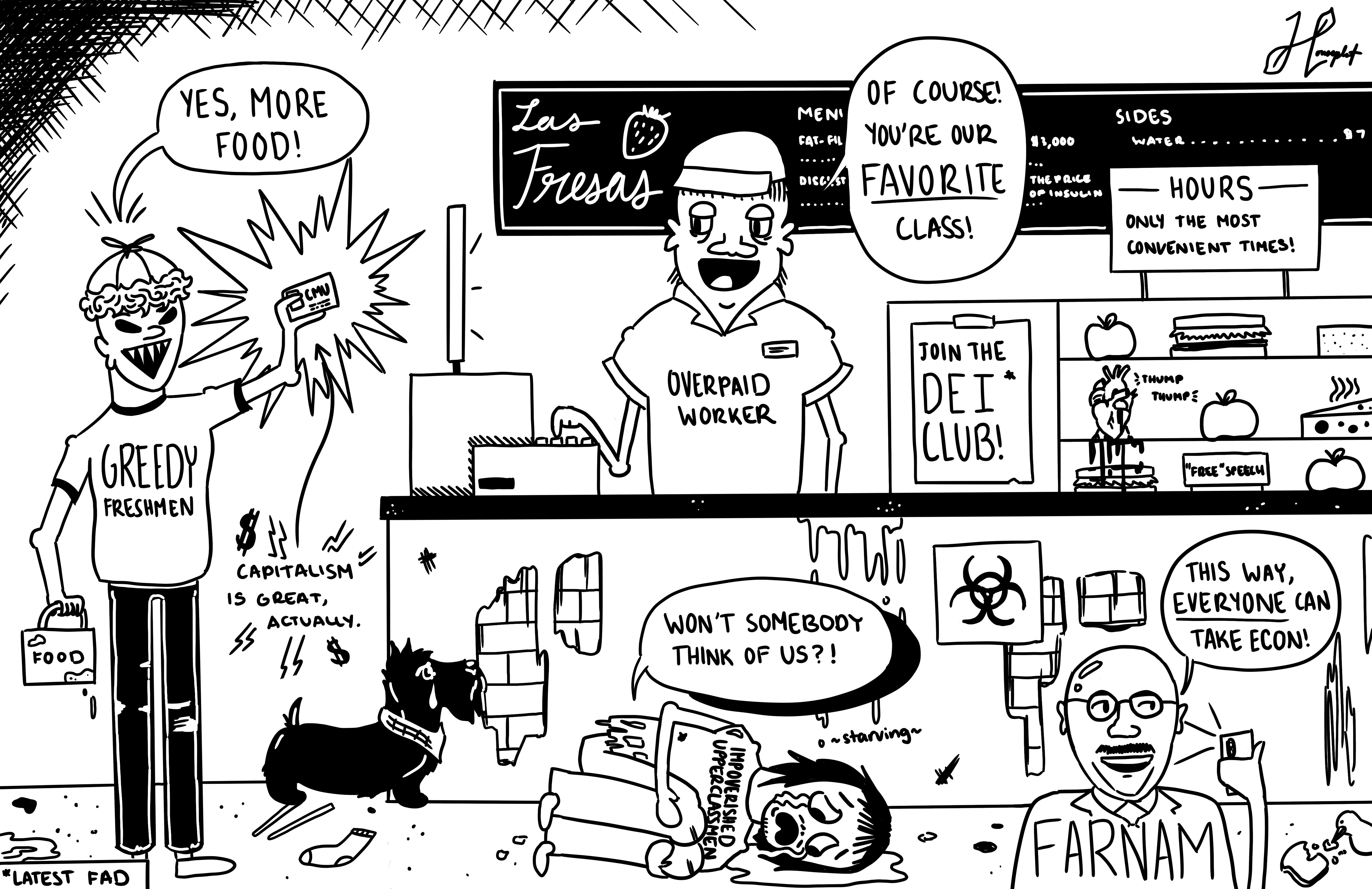
October 29, 1929: "Block Tuesday" Leaves Freshmen Destitute
At Carnegie Mellon University, the end of the 1920s saw unprecedented financial ruin for many first-year students. The meal-block economy had crescendoed throughout the decade, with blocks selling for a whopping 50% of their original worth. Unfortunately, this lucrative exchange could not last forever. The block market imploded, wiping out the assets of many ambitious traders. Freshmen everywhere lost their investments, their savings, and their bananas of varying ripeness.
The crash created a dire economic situation on campus. Thousands showed up to the bread line every day, hoping Au Bon Pain had enough rustic baguettes to sustain them during …
Evolution of Hetero Sapiens
Up until the 1960s, the student body of Carnegie Mellon University consisted solely of gay men. Passionate academic rivalries and long nights in the lab together fostered a thriving homosexual population at CMU. De Fer ran out of iced coffee by 8:03 every morning, and the CMU Philharmonic played nothing but Lana Del Rey covers. When Margaret Morrison Carnegie College opened in 1969, its female students rarely interacted with men, choosing instead to recite Greek poetry while tasting each other’s lipstick. For decades after its founding, CMU saw little in the way of male-female contact. No one was ready for …
Fruity Take on CMU Housing
Back when Welch's was just a grape juice company, Andrew Carnegie was their biggest fan. In fact, in 1905, he built the beloved Welch House in the company's honor (and for a very generous donation) similarly to the Giant Eagle Auditorium or the Trojan Center for the Performing Arts.
Unfortunately, despite Welch House's small capacity, Carnegie's small trade school of white men did not have enough people to fill the dorm. After years of Welch House sitting empty, the 1969 CMU president H. Cortland Matthews decided to get creative.
In the golden age of communism and good guitar …
Medieval era Comedy Manuscript found
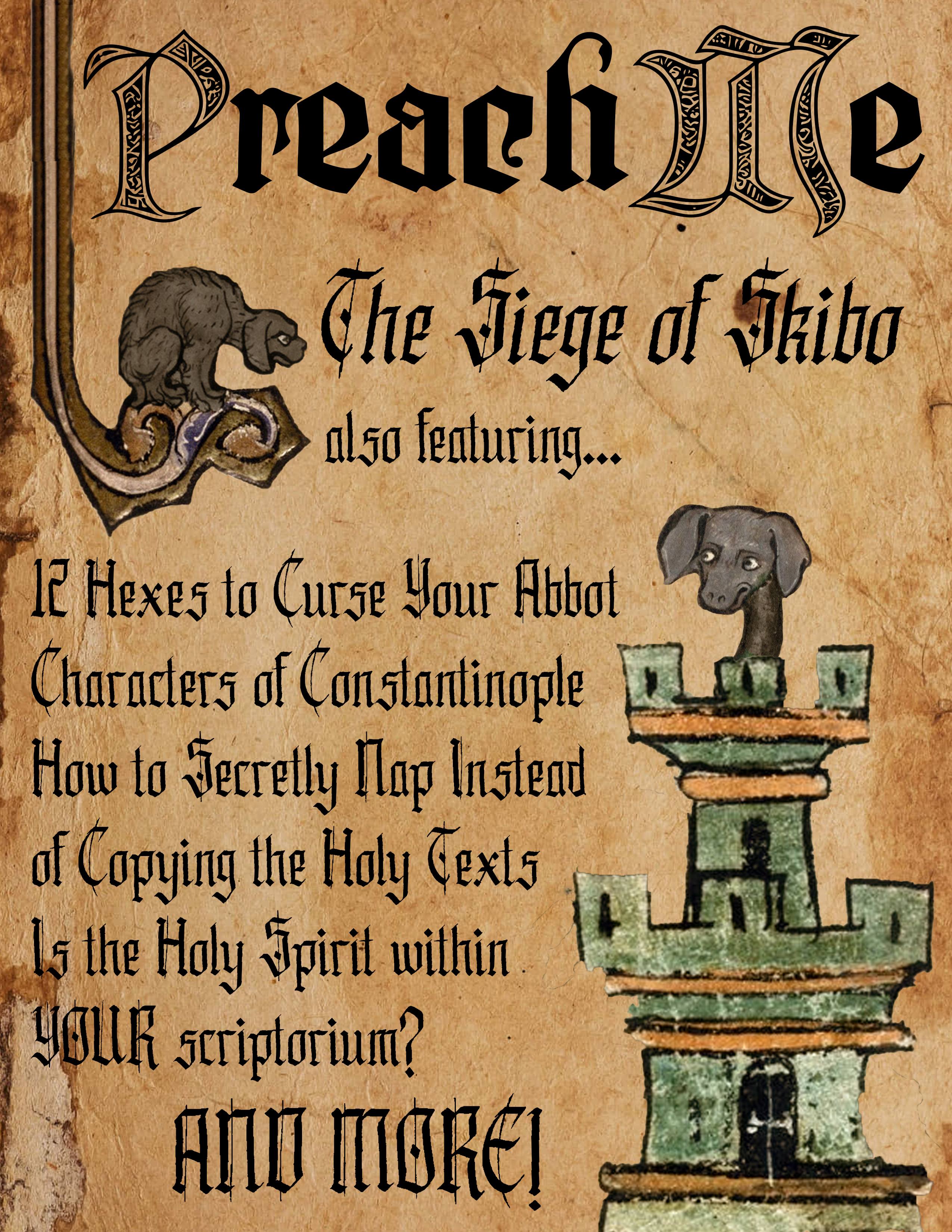
Archeologists in northern Greece have recently unearthed a seemingly comedy-themed manuscript dating back to the 6th century. Found during the excavation of the famed Skibo monastery, the manuscript was titled PreachMe and included articles poking fun at everything from strange-looking icons to priest pet peeves. PreachMe appears to have been hand copied at Skibo before being circulated between various other Byzantine monasteries. No other surviving copies have been found. Although most of the manuscript is too damaged to be read, a brief excerpt of the article “The Siege of Skibo” has been translated below:
…the invading Horde …
On the origins of buggy
In modern day, it can be difficult to recollect the scrappy origins of the noble sport of Sweepstakes. Informally known as Buggy, this pastime today takes the form of small carbon fiber capsules being pushed along a set route through Schenley Park, steered by students of short stature and tall courage. But it wasn't always this way.
Approximately 2,800 years ago, an odd four legged creature roamed North America. Fossils indicate it looked somewhat similar to a goat, but with shorter, thicker legs. When standing its height was just above waist height for the average adult human, and …
ReadMe Bets Entire Budget on Landslide Mondale Election Victory
It’s not the 70s anymore. Hippies are out. Snorting cocaine in a yuppie penthouse is in. ReadMe is playing it fast and loose, strutting down Wall Street with slick backed hair, a new suit, and a son named ReadMe Jr. with a distant look in his eyes and a baseball game tonight. It’s 1984, and ReadMe is just getting started.
The markets are roaring. The lines are going up and then down a little and then up more. Telephones are getting slammed down at an unprecedented rate. ReadMe needs to move fast.
After countless sleepless nights drinking fine …
The Wheel and its affects on our children
It’s the latest craze, the vogue, a revolution, and it’s rolling off the shelves. If you’ve lived in ancient society in the last few lunar cycles, you’ve heard of it: the wheel.
The wheel has transformed our world swiftly; be it agriculture, transportation, cheese, or construction, they’ve already become integral to every part of our lives. But people are starting to realize that behind the gleaming facade of the wheel lies a sinister consequence: its effect on our own kids.
“It’s like I don’t even recognize him anymore,” says one anonymous mother. “It used to be ‘Dinner’s ready!’ …
Before Baker and Porter, they were Hunter and Gatherer
Baker Hall and Porter Hall: We all know them, love them, get lost in them, and indulge in erotic fanfiction of them from time to time. “But what you may not know is their deep and rich history of cultural evolution,” says anthropologist X. Cavator.
“It’s easy to look at these buildings standing tall and proud, Baker, Porter, Wean—actually, not Wean, Wean’s got nothing to be proud of—but it’s easy to look at them and feel they’ve always been that way. Yet, buildings are not the stalwart monuments we’ve always thought of them as. They can grow and change …
Sanitation Concerns Raised over Birth in Bethlehem Stable
BETHLEHEM, Judea – Locals are shocked that a young Galilean woman named Mary has given birth in a manger. Although many have no qualms about sharing their living spaces with domesticated animals, some are saying that a stable might be a bit too far. Experts confirm that a manger is not a suitable environment for childbirth, referencing the statistic that 6% of women die in childbirth already. Giving birth in an unsanitary stable surrounded by donkeys, cattle, and goats raises the possibility that Mary will contract donkey-borne illnesses such as leptospirosis or brucellosis, increasing her chance of death to 19%. …
CMU was always a social experiment
Carnegie Mellon. You all know the name – founded in 1900 with the supposed intention of being a “technical institution” where our “hearts are in the work.” These are all lies that you have been fed by Big Behavioralism, because we know the real reason that CMU was founded.
At the start of the 20th century, unethical experimentation was rampant. People were subjected to conditioning after Pavlov was able to train his dogs. Before John B. Watson’s experiment conditioning a nine-month-old infant to fear fluffy things, the behavioralists had another idea – starting a university where the only objective …
History's first booth
HUNT SPECIAL - Carnegie Mellon University’s springtime Carnival brings with it many beloved traditions, perhaps most recognizable of all, Booth, a weeklong mad sprint through constructing marvelously untrustworthy houses. But did you know that the roots of booth trace back to far before CMU’s founding? Back before the scientists of our society had invented steel, universities, or Scotsmen, one ancient society was building immense, elaborate towers and tearing them down in a hurry, a practice that has traced its way to our school today. Chasing the roots of CMU’s most beloved culture, we come to explore the city of Babylon.
…
Interwar Update
Once again, we’d like to thank you, dear reader, for continuing to stick with readMe through these turbulent times. You probably never imagined that the US government would declare us illegal, but alas, much like cocaine and alcohol before us, it seems like Uncle Sam has a penchant for criminalizing what gives the populace joy. We had always worried that our affiliation with a “KGB” might someday cast unwarranted suspicion on us, though. We’d like to explain how we’re relatively harmless, but the Kennedy administration is refusing to hear us out. Until that time, you'll just have to bear with …
A Letter from the Editor
As you may or may not know, ReadMe has been around since the dawn of time. We’re so old, in fact, that for our first volumes we were called TellMe. We orated about the Big Bang, the age of the dinosaurs, and the evolution of humanity. Once we could write, we reported on events like the flood (remember reading about Noah? We covered that.) and the fall of the Roman Empire. Eventually we decided that our purpose was to bring humor to the saddest place in the world, and once CMU was founded, we knew we’d found our forever home. …
An Open Letter to William Shakespeare
How now, sirrah, churlish Bard, bacon-fed knave!
Thou damned and luxurious mountain goat who taketh the name “William Shakespeare,” take heed! Thou seducest the innocent masses into sin with thy profane plays and pompous poetry. We address our grievances in the style thou’rt most fond of: the sonnet.
Thy plays draw foolish sheep like flies to mead,
Deserting Sunday mass for comedy.
Marry, that time is better spent to read
That holy, worthy folio, ReadethMe!
To lull the mind with idle merriment
Shall push literacy into decline.
Thy noble patron in his …
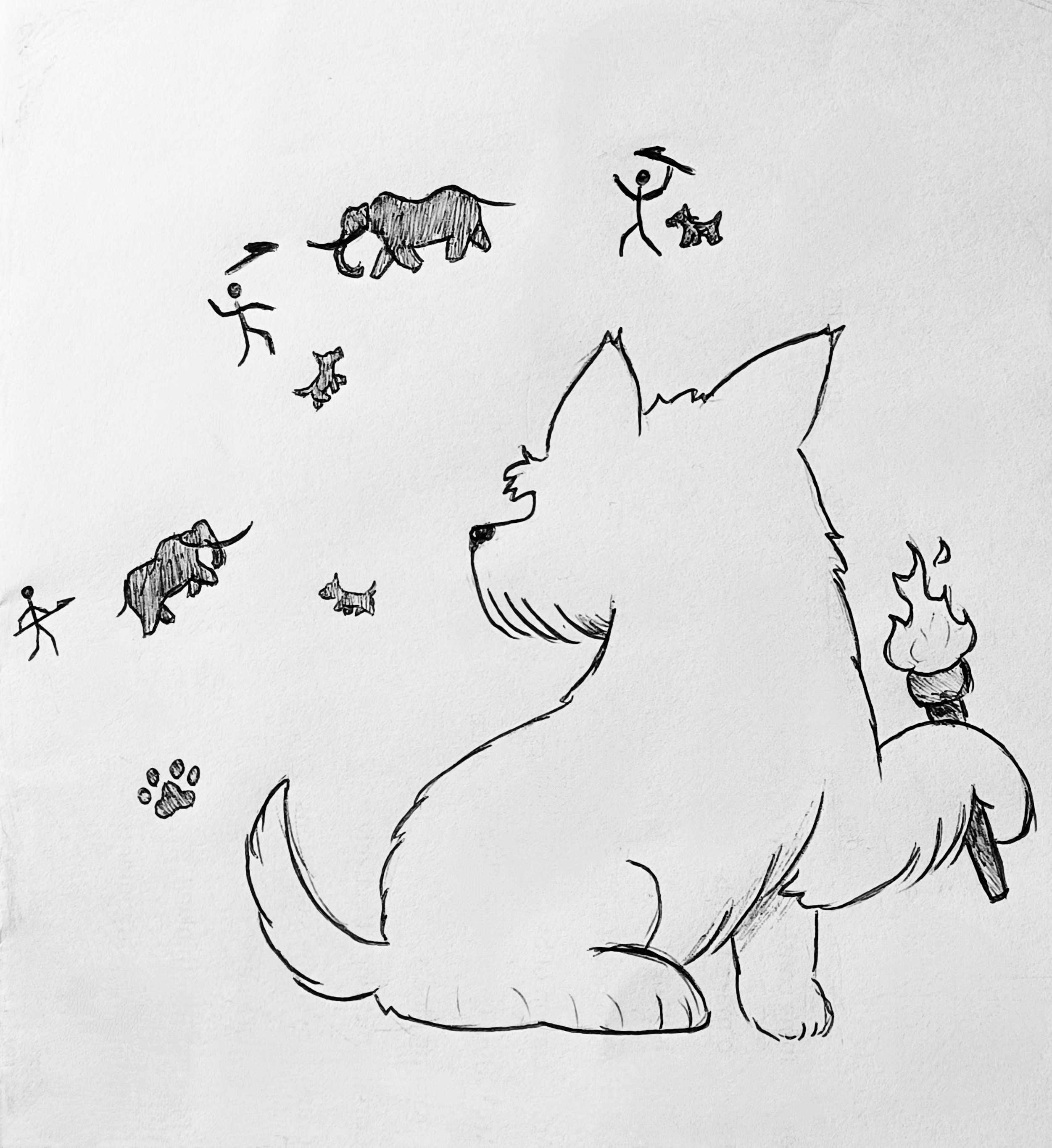
Paleolithic tribe discovered in ancient Pittsburgh cave system
A routine safety inspection of the steam tunnels beneath Carnegie Mellon University went awry when an unexpected wall collapse revealed the heart of a still living ancient empire. When FMS workers attempted to survey the oldest section of CMU’s steam tunnels last Sunday, they accidentally triggered a minor sinkhole. The workers escaped unharmed; however a large section of wall and flooring collapsed to reveal a previously unknown cave tunnel. The tunnel leads into a complex underground network of passages and natural caverns full of primeval artifacts completely untouched by time. The most shocking part? People were still living there.
…
Readme's production in decline due to Prohibition
The pervasive hum of the printing press putting out Readme’s weekly dreck has finally faltered. A well-meaning administrator, upon hearing the rumor the magazine runs on a 70/30 blend of grain alcohol and caffeine, initiated a campuswide effort to enforce the national ban on spirits. The goal was to improve its output, but the fallout has been dire.
The Readme office, once a vibrant den of inspired madness, resembles a UPMC autopsy center. Editors, now tragically lucid, are unable to reach their highs of maniacal, drug induced criticism. Writers are submitting coherent, factchecked articles that one disgusted reader criticized …
Students Rush to Graduate as End of World Looms
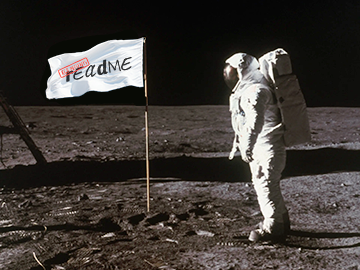
DECEMBER 20, 2012 - While CMU students have always tried to graduate in less than 8 semesters, only the quickly approaching demise of all life on Earth could incentivize even the most burnt out underachievers to get their degree before spring. Despite astronomers’ insistence that Sagittarius A* is too far away to cause any gravitational disruptions, professors are still drowning in capstones about how said black hole affects the futures of every single major. “Grading is somehow more repetitive than usual,” states one anonymous TA. “There’s usually some variety, but when we’re all gonna die tomorrow, that’s the only thing …
Snowstorm Hits Donner, Proclaimed "Still Livable"
Larry: Good evening. We're coming to you live from the arctic tundra that was once the campus of Carnegie Mellon University, where the great Blizzard of '48 has crippled the nation and, more importantly, threequarters of a freshman dorm. I'm here with first-year student Kevin, who is currently enjoying his week’s ration of a single bag of artisanal dehydrated kale chips. Kevin, thank you for joining us. What's the situation like inside Donner?
Kevin: Well, Larry, it's pretty dire. The power and heating in half the building is out, which means we’ve had to put fourteen people in each …
Heart not in work, striking Homestead workers declare
After weeks of refusing to stay working at the steel mill past 2 a.m., employees at Homestead Steel Works have finally gone on strike. They are protesting outside the factory, saying that working all day without a lunch break is “unethical.” Some complain they have not been home to visit their families in months, hoping to desert their sacred duty to make the billionaire Andrew Carnegie more money. The strikers should rest easy knowing that their hard labor is going into the construction of libraries and museums they will never be able to see.
The Amalgamated Association of Iron …
Taste-testing Messiahs
Pretty often now, we'll have these bearded fucks wander into the temple telling us they're the savior we were promised. They like to wash people's feet (a little too much honestly), and go on and on about the true spirit of the holidays, until someone rich bothers to have them strung up in the public square or torn apart by horses.
But first, we always make sure to taste test the would-be savior. We know, after all, that whoever we accept as our savior, we'll have to taste a little bit of every Sunday for the rest of our …
![[TODO]](/media/vol4/issue2/images/toobigbear_KJwlH5h.png)